Unit Converter
Convert length, weight, temperature, area, volume and more online. 40 units across length, weight, temperature, area, volume, time and speed: type a value and get the result instantly.
How to use
- Pick a category first: length, weight, temperature, area, volume, time or speed.
- Choose the "From" unit on the left and the "To" unit on the right, then type the value you want to convert.
- The result updates as you type. Click "⇄ Swap" to flip the two units, or "Clear" to reset the input.
FAQ
Are the conversions accurate?
How are "month" and "year" defined?
Which units are supported?
Screenshots
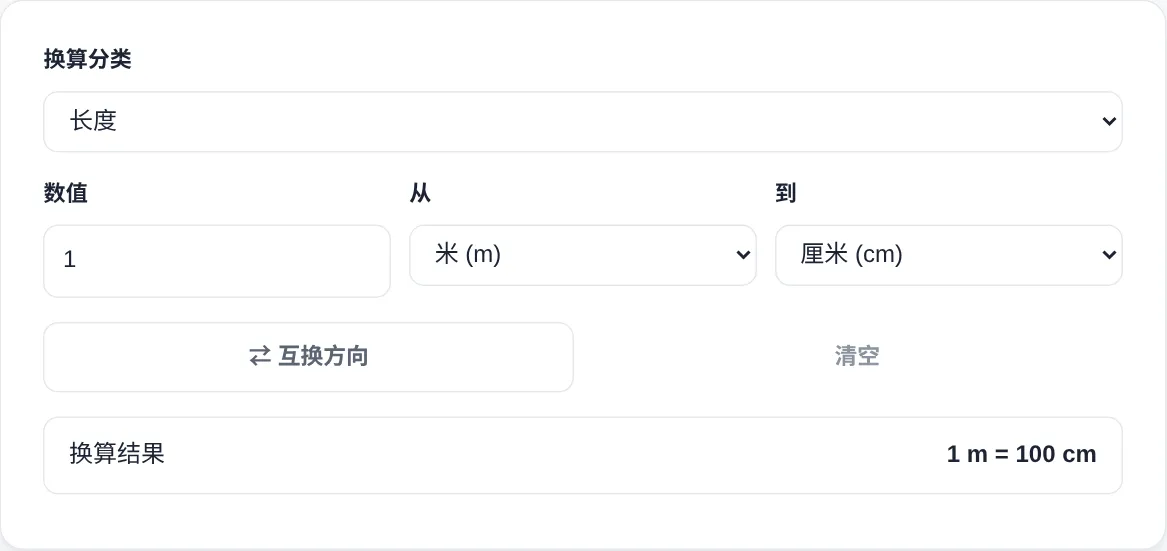
How to use
- Pick a category first
Open the category dropdown: length, weight, temperature, area, volume, time or speed. The seven groups hold about forty common units.
- Set the from and to units
Choose the source unit in the From dropdown and the target in the To dropdown. Examples: inches to centimeters, or pounds to kilograms.
- Type a value
Enter any number in the value box and the result updates as you type. Press the swap button to flip both units instantly without re-selecting them.
- Mind temperature formulas
Temperature is not a simple factor. Celsius, Fahrenheit and Kelvin convert through standard formulas. Fahrenheit subtracts 32 first, then multiplies by five ninths.
- Clear and continue
Press Clear to reset the value field before the next conversion. Switching categories refreshes the unit lists automatically.
About this tool
The tool bundles about forty common units in seven categories: length, weight, temperature, area, volume, time and speed. It converts with internationally accepted factors. One inch equals 2.54 centimeters, and one pound equals 0.45359237 kilograms. Temperature uses the standard formulas between Celsius, Fahrenheit and Kelvin. Results are rounded to at most ten significant digits, which suppresses floating-point noise. Everyday and technical work can both rely on the output.
It fits international students checking course units, shoppers comparing inches with centimeters, and cooks converting pounds to grams. Gym-goers juggle kilograms and pounds, and developers sanity-check API data. Month and year are average definitions: a year counts 365.25 days (the Julian year) and a month about 30.44 days. That is fine for rough estimates. For billing cycles or precise scheduling, always verify against the real calendar.
How it works
The factors are trustworthy because international agreements fix them exactly. The 1959 international yard-and-pound pact pinned one inch at exactly 25.4 millimeters and one pound at exactly 0.45359237 kilograms. Imperial-to-metric is therefore a precise relationship, not an approximation; before that pact, the inch and the pound differed slightly between the two countries. After the 2019 SI redefinition, the metre hangs on the speed of light and the kilogram on the Planck constant. All seven base quantities now anchor to physical constants and will not drift again for decades.
Temperature is the lone special case. Celsius, Fahrenheit and Kelvin differ by an offset as well as a scale, so the conversion is affine rather than proportional. Subtract first, then multiply; the order cannot be swapped. Fahrenheit to Celsius subtracts 32 and multiplies by five ninths, and the reverse multiplies by nine fifths before adding 32. Floating point hides a classic trap of its own: binary formats cannot represent 0.1 exactly, so naive arithmetic produces tails like 0.30000000000000004. The noise accumulates across chained conversions, and rounding every result to ten significant digits keeps the output clean and readable.
When to use it
- Checking a monitor against your desk
A retail 27-inch display is 68.6 centimeters wide; converting before you reach for the tape beats eyeballing it. The same move settles whether a suitcase clears an airline's stated linear-size limit before you leave for the airport.
- Converting American recipes
A US recipe cup is roughly 236.6 milliliters. Translate cups and fluid ounces into milliliters before you start, because baking punishes eyeballed ratios far more harshly than stovetop cooking ever does.
- Translating running paces
Training plans written in minutes-per-mile need translating for kilometer tracks. A 5-minute kilometer is about an 8-minute mile, and the speed category converts the target pace in a single entry, making training intensity comparable.
Tips & tricks
- Got the direction backwards? Hit the swap button instead of re-picking both units from the dropdowns.
- In the time category a year is 365.25 days, so calendar-exact schedules still need a real calendar.
- Area includes hectares and acres: one hectare is 10000 square meters, one acre about 4047 square meters. Mixing the two up is common.
Things to watch
- US and imperial liquid units differ
A US gallon is about 3.785 liters while the imperial gallon runs about 4.546. That is nearly a fifth apart, and pints diverge the same way. Confirm which system a figure uses before picking the unit and converting.
- Miles and nautical miles are different
A statute mile is 1609.344 meters; a nautical mile is 1852, roughly 15% longer. Aviation and shipping distances converted as statute miles come out badly underestimated, so identify the unit before applying any factor.
- Ten digits do not create precision
When the input is an estimate, the long tail of decimals means nothing. Significant-digit rounding guarantees the conversion adds no error; it cannot make the original measurement more accurate than it ever was.