BMI Calculator
Calculate your Body Mass Index with category reference. Enter your height and weight to get your BMI, its weight category and the healthy weight range for your height: all calculated locally in your browser.
How to use
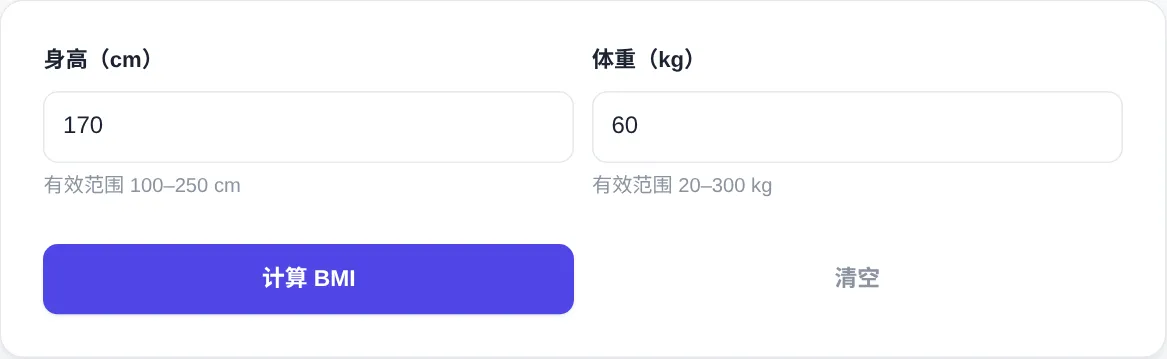
- Enter your height in centimeters and your weight in kilograms.
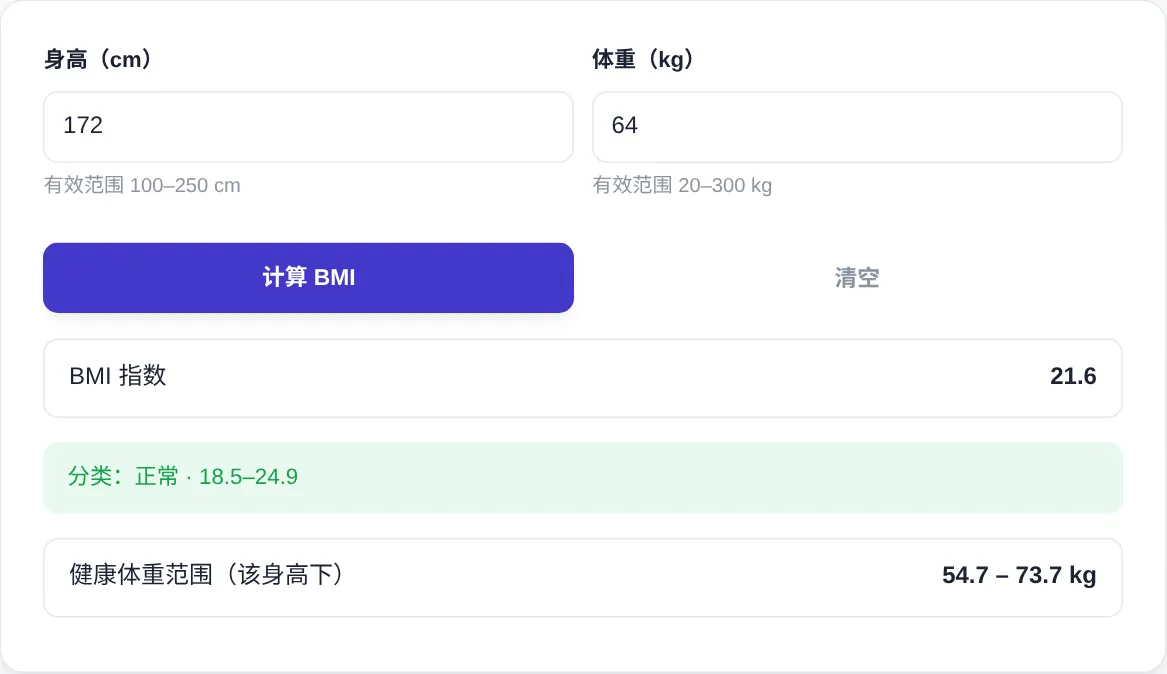
- Click "Calculate BMI" to see your BMI (rounded to 1 decimal place) and its weight category.
- Below the result you'll also find the healthy weight range for your height: the weights that put your BMI between 18.5 and 24.9.
- Click "Clear" whenever you want to start over.
FAQ
How is BMI calculated?
What are the weight categories?
How is the healthy weight range derived?
Is BMI suitable for everyone?
Screenshots
How to use
- Enter height and weight
Type your height in centimeters (100-250) and weight in kilograms (20-300). Decimals are allowed, and more accurate inputs give a more useful result.
- Calculate your BMI
Press Calculate BMI. The value equals weight divided by squared height in meters, shown to one decimal place with the WHO weight category attached.
- Read the healthy range
Below the result you get the healthy weight range for your height: the weights that keep BMI between 18.5 and 24.9. Use it as a concrete target.
- Interpret it with context
BMI is a screening number only: muscular people may read as overweight, and children or pregnancy are out of scope. Consult a doctor for real planning.
About this tool
BMI, or Body Mass Index, divides your weight in kilograms by the square of your height in meters. It is the standard first-pass indicator for weight status. This tool classifies adults on the WHO scale. Under 18.5 is underweight, 18.5 to 24.9 normal, 25 to 29.9 overweight, and 30 or above obese. It multiplies the 18.5 and 24.9 boundaries by your squared height to derive the healthy weight range. Everything computes locally in your browser.
It suits adults checking where they stand before or after a physical exam, or setting a starting point for a cut or bulk. Know its limits before acting. BMI cannot tell muscle from fat, and it ignores fat distribution such as visceral fat. It is unreliable for athletes, elderly people and children. Treat it as one signal alongside waist circumference, body-fat rate and professional medical advice, never as a diagnosis.
How it works
The index goes back to Adolphe Quetelet, a nineteenth-century Belgian statistician, and was named and popularised by the physiologist Ancel Keys in 1972. It was built as a screening tool for populations, never as a per-person diagnosis. The formula squares height, so at the same build, taller people read lighter. BMI is therefore lenient on tall frames and strict on short ones. That bias is the price of describing a non-linear body with one linear formula. It does not separate muscle from fat.
The cutoffs are not universal. WHO draws the overweight line at 25 and obesity at 30. Studies show Asian populations developing metabolic problems at lower readings, so Chinese guidance sets overweight at 24 and obesity at 28. This tool reports the WHO scale. If your local checkup uses the 24/28 standard, the labels will differ. That is a matter of which standard applies, not a calculation error. Only the labels differ between the two scales.
When to use it
- Turn a checkup into a target
When a report flags your weight, confirm the category here. Convert the healthy range into the exact kilograms to lose, and an abstract suggestion becomes a number you can plan around.
- Track a cut or a bulk
Log BMI as a trend line next to waist circumference and body-fat rate. If weight climbs while the tape measure holds steady, muscle is the likelier explanation.
- A family health ledger
Record height, weight and BMI for each adult at home and file the numbers with their checkups. Children need age-and-sex growth charts instead, so keep the two systems separate.
Tips & tricks
- Work backwards from the healthy range to set a goal. That is easier than chasing the BMI number itself.
- A high BMI from large muscle mass is expected; body-fat percentage or waist-to-height ratio describes fitness better.
- The inputs are metric only. Convert pounds and feet to kilograms and centimeters first, or the result will be wrong.
Things to watch
- Height errors get squared
Losing one recorded centimeter inflates BMI noticeably, and the same person can measure 1-2 cm shorter by evening. Measure in the morning, standing tall against a wall, so numbers stay comparable.
- Short-term swings are noise
Dehydration, water retention or a heavy meal can move weight by a kilogram or two within a day, and BMI follows. Judge from several stable weeks, never from a single reading.
- Older adults need looser lines
Geriatric guidance often shifts the lower bound upward, where mild extra weight can be protective. Applying 18.5 blindly underestimates risk, so involve a doctor and consider muscle mass.