Ovulation Calculator
Predict ovulation day, the fertile window and your next period from your cycle
How to use
- Pick day one of your most recent period as the start of the current cycle.
- Enter your cycle length. The default is 28 days, and a multi month average is more accurate.
- The box shows the predicted next period, ovulation day and the six day fertile window.
- Trying to conceive: plan intercourse every other day inside the window. Avoiding pregnancy: do not rely on this page.
- To confirm real ovulation, add test strips or morning basal temperature to the calendar estimate.
Method and terms
How is the ovulation day estimated?
Why does the fertile window span 6 days?
Can sex right after the period cause pregnancy?
Does it work with irregular cycles?
Common questions
Is the calendar method reliable for contraception?
How can I confirm that ovulation really happened?
How do test strips relate to this tool?
Is my input uploaded?
Screenshots
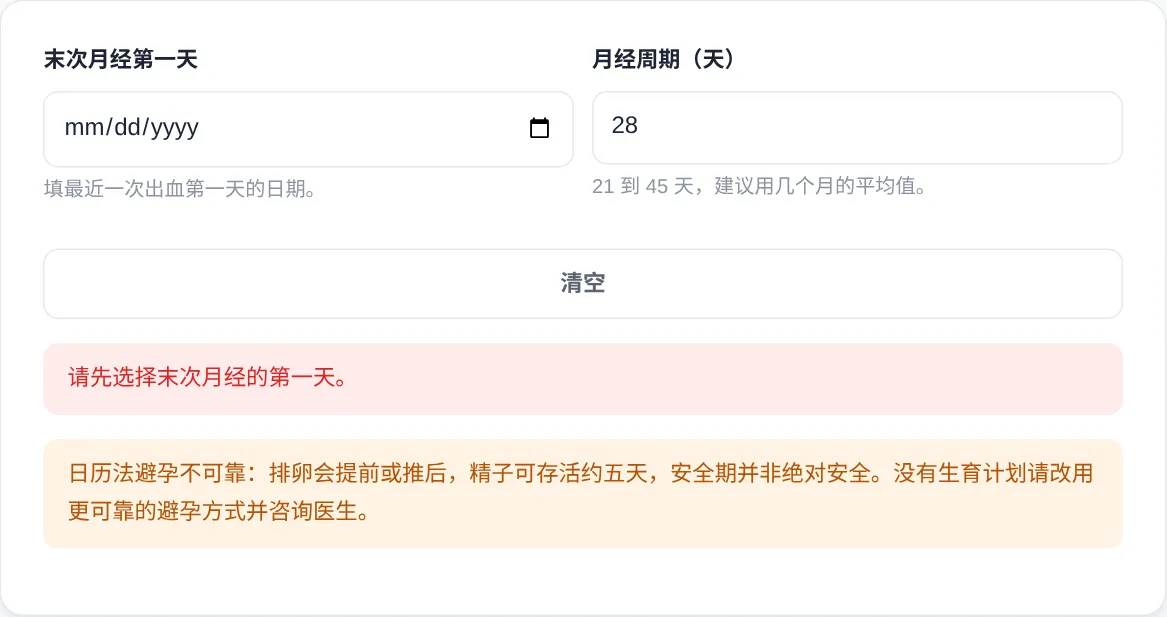
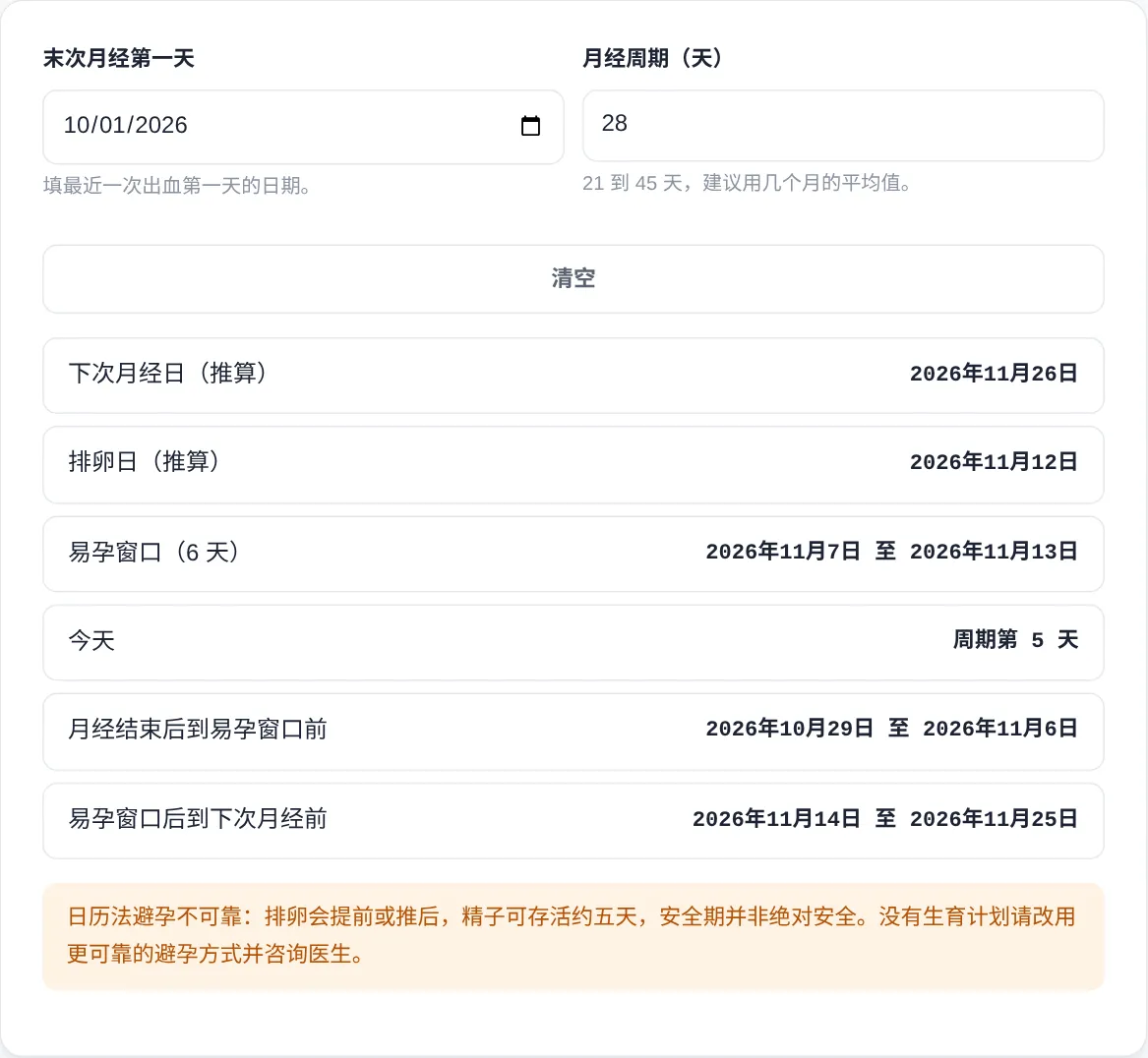
How to use
- Enter the last period
Pick day one of your most recent bleed. The tool treats it as the start of the current cycle and works forward from there.
- Confirm the cycle length
The default is 28 days. A multi month average works better, and any value from 21 to 45 is accepted. Erratic cycles give rough results only.
- Read ovulation and the window
Ovulation sits 14 days before the next period. The fertile window spans the five days before plus the day after, six days in total.
- Treat safe days with care
Days outside the window are only relatively safe. The calendar method is unreliable for contraception, so pick a proven method instead.
About this tool
After a period ends, follicles mature and estrogen rises. A surge of luteinizing hormone triggers ovulation about a day or two later. Once the egg is released the luteal phase begins, and without pregnancy it holds a fairly steady 14 days before the next bleed. The follicular phase before ovulation varies far more between people and between cycles. That difference is why the calendar rule counts 14 days back from the next period. The survival spans of sperm and egg then mark the six day fertile window.
This tool takes day one of your last period as the current cycle. It adds your cycle length to find the next period, then steps back 14 days for ovulation. It marks the six day fertile window and lists two relatively safe stretches outside it, plus today's cycle day. Everything runs locally and nothing is uploaded. The estimate suits people with regular cycles as a planning aid, and it is neither a contraceptive method nor medical advice. For birth control, talk with a doctor about proven options.
How it works
The calendar method traces back to Ogino and Knaus, who published their rules in the 1930s. It rests on three observations. The luteal phase holds near 14 days. Sperm survive about five days inside the body, and the egg stays fertilizable for roughly 12 to 24 hours. Counting 14 days back from the next period estimates ovulation, and the five days before plus one day after give the six day window. The rule assumes a regular cycle, so it sketches a statistical window rather than measuring one real ovulation.
The limits matter. Even regular cycles shift under stress, illness, travel or breastfeeding, and some cycles release no egg at all. As contraception, the calendar method fails far more often in typical use than intrauterine devices or hormonal options. More reliable ways to confirm ovulation include luteinizing hormone test strips, morning basal body temperature and ultrasound follicle tracking. If avoiding pregnancy is the goal, talk with a doctor about proven methods, and treat this page as an estimate only.
When to use it
- Plan for conception
Couples trying for a baby can map the fertile window from their cycle and plan intercourse every other day inside it. That rhythm catches the egg without draining either partner, and days outside the window carry no obligation. A calm pace is easier to keep across the months a healthy attempt usually needs.
- Pair with ovulation tests
Start testing luteinizing hormone a few days before the predicted window begins. When a strip turns strongly positive, schedule intercourse that day and the next. The calendar gives the search range and the strips give the signal, and together they land closer to the real ovulation day than either alone.
- Learn your own rhythm
Log the predicted date next to the date your period actually starts. After a few months you can see whether your cycles run regular and whether the second half holds steady. Persistent gaps deserve a doctor visit, and the record itself is more valuable than any single prediction.
Tips & tricks
- Record at least six cycles and enter the average, which beats any single memory of your length.
- To pin down the day, combine test strips for the hormone surge with morning basal body temperature.
- For conception, plan intercourse every other day inside the window instead of hunting one exact hour.
Things to watch
- Using it as contraception
The calendar method fails often in typical use, because ovulation drifts and sperm can wait up to five days. Couples with no plans for a baby who rely on safe days see many surprise pregnancies. Barrier methods, hormonal options or an intrauterine device protect far better, with medical advice.
- Fixing ovulation at day 14
Day 14 belongs to a 28 day cycle. People with 32 day cycles often ovulate near day 18, so a fixed day 14 misses by four days. Counting back from the next period adapts to your length, while the fixed day never does.
- Judging from one result
A single cycle reflects that month's stress, sleep and travel, and ovulation can slide. Watch at least three cycles before calling a pattern. Bring the record to a doctor when planning pregnancy or investigating irregularity, because the trend is the useful part.