Daily Water Intake Calculator
Estimate daily water needs from weight, exercise, pregnancy and climate
How to use
- Enter your weight, the main variable of the baseline at 35 ml per kilogram.
- Enter daily exercise hours. Halves like 0.5 work, and each hour adds 400 ml.
- Tick pregnancy, lactation or hot climate. Pregnancy and lactation are mutually exclusive.
- The box shows total fluids, the drinking target at eighty percent and the count of 250 ml cups.
- The breakdown lists every part, so each input change is visible and easy to tune.
Method and sources
Is 35 ml per kilogram evidence based?
Why is the drinking target eighty percent?
Do tea, coffee and soup count?
Who should not follow this result?
Common questions
Is 400 ml per exercise hour enough?
Can drinking too much be harmful?
How do I know I drank enough?
Is my input uploaded?
Screenshots
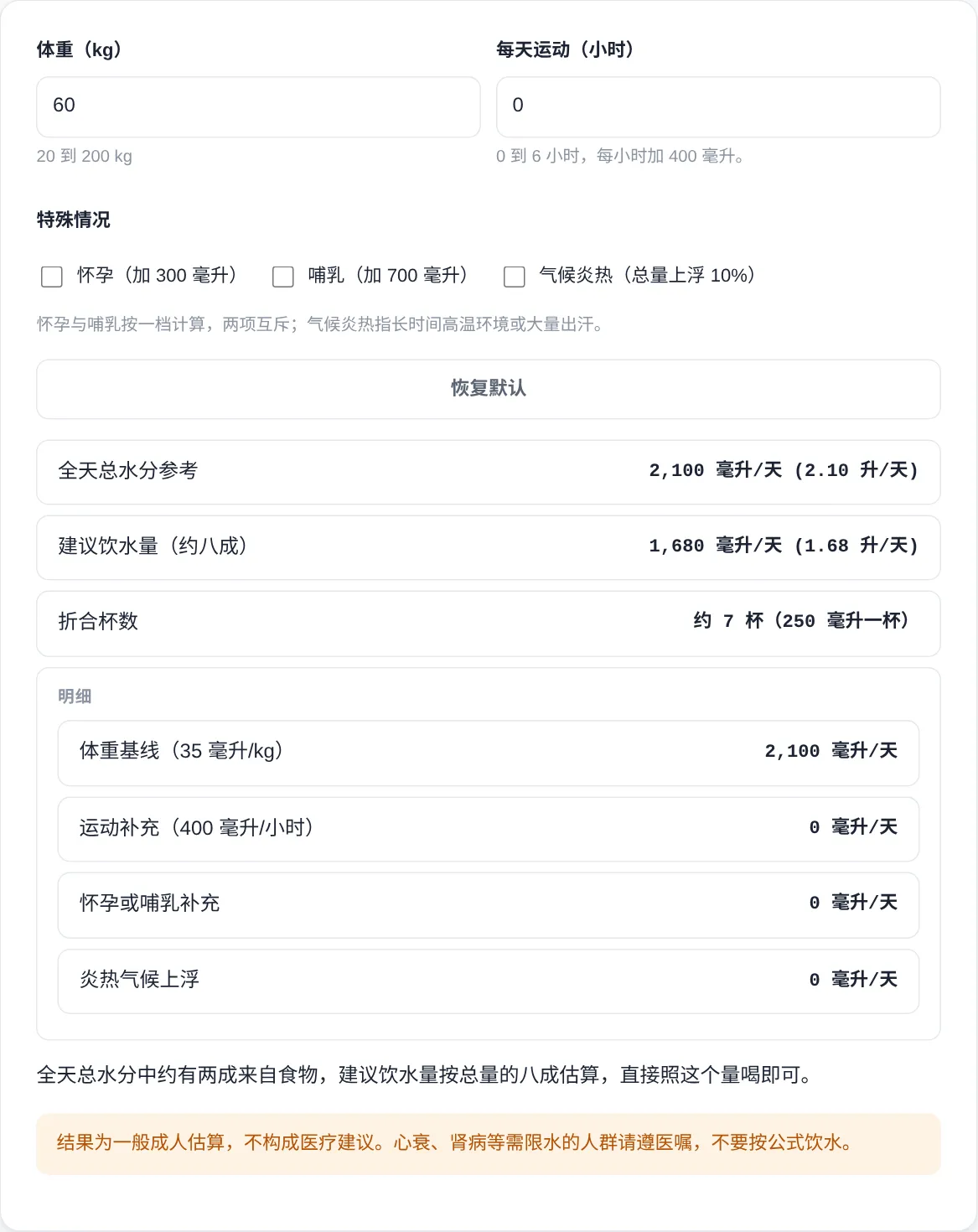
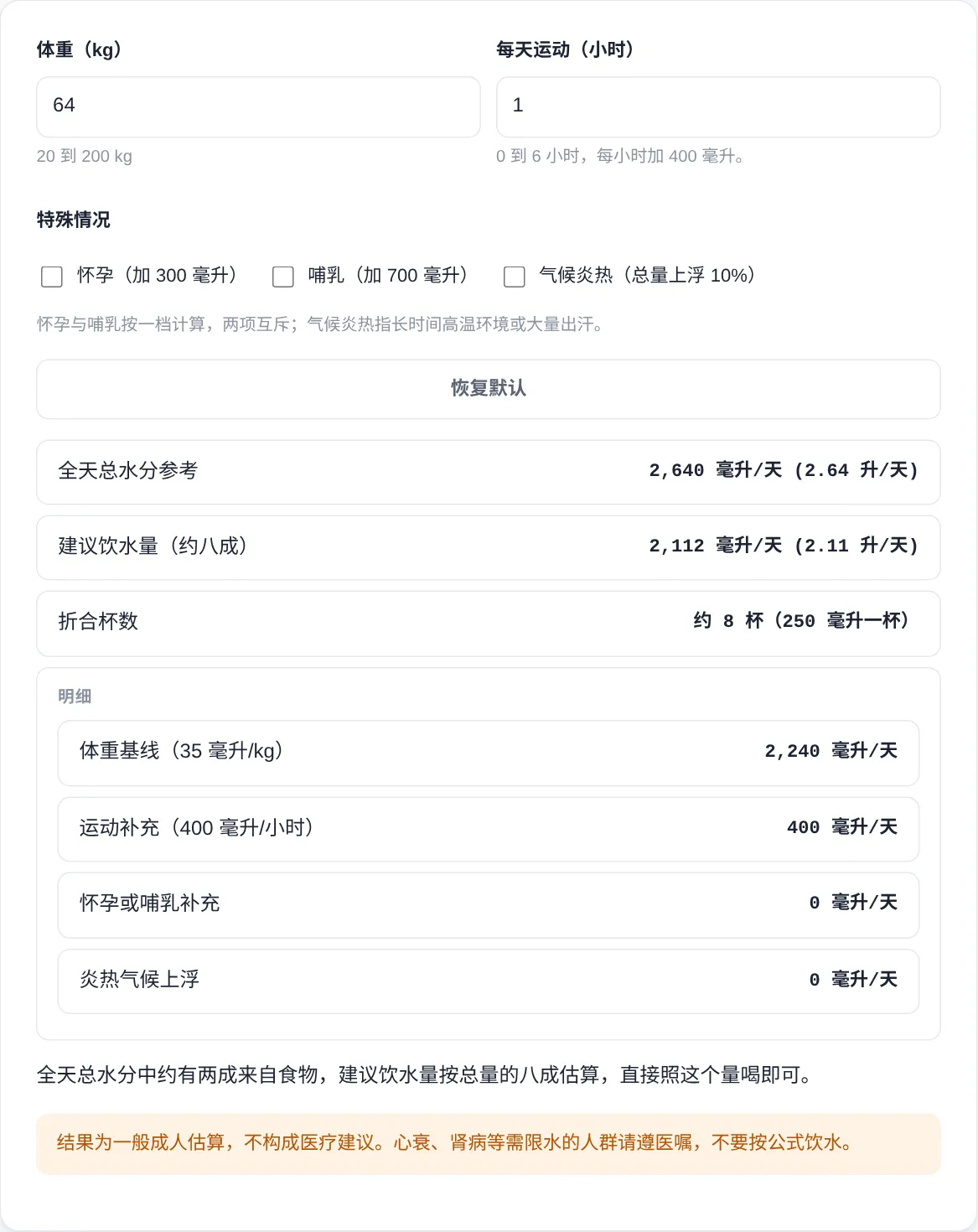
How to use
- Enter weight and exercise
Body weight drives the baseline. Exercise hours accept halves such as 0.5, and both values feed the estimate live.
- Tick special states
Pregnancy and lactation each add a fixed amount, and the two are mutually exclusive. Hot climate lifts the subtotal by a tenth.
- Read total and drinking target
The box shows total fluids first, then a drinking target at about eighty percent. Cups are converted at 250 ml each for easy pacing.
- Adjust with the breakdown
Baseline, exercise, pregnancy and climate list separately, so every input change is visible and easy to fit to your routine.
About this tool
Water regulates temperature, carries nutrients and flushes metabolic waste, and it is the largest component of the body. Adults lose fluid continuously through urine, skin evaporation, breath and stool, and urine alone rarely drops below about 500 ml a day. By the time thirst appears the body has usually been short of water for a while, so waiting for thirst often leaves people mildly dehydrated. Steady sipping beats large gulps, and hot weather, heavy sweating, pregnancy and lactation all raise the requirement well above the baseline.
This tool starts from 35 ml per kilogram of body weight, a common adult estimating rule, and adds 400 ml per exercise hour. Pregnancy adds 300 ml, lactation adds 700 ml, and the two are mutually exclusive, while a hot climate lifts the subtotal by ten percent. Roughly a fifth of total water intake normally comes from food. The drinking target therefore shows eighty percent of the total, converted into 250 ml cups. The breakdown lists every part, all calculations run locally, and the last inputs stay on this device.
How it works
Health agencies frame needs as total water. European recommendations put adult men near 2.5 liters and women near 2.0 liters per day from drinks and food together. Food contributes about a fifth of that. Clinical rules of thumb estimate 30 to 35 ml per kilogram, and this tool takes the higher 35 ml as a conservative baseline. The 400 ml per exercise hour suits moderate effort, and heavy sweaters should dose by weight change instead. The kidneys clear a limited volume per hour, so drinking faster than that can dilute blood sodium, a state called hyponatremia.
Limits apply. Sweat rates differ widely between people, and the tool can only give general values. Identical exercise produces very different losses depending on heat and humidity. Patients with heart failure, kidney disease or cirrhosis are often told to restrict fluids, and late pregnancy with edema needs medical guidance too. This page estimates needs for healthy adults, it does not cover fluid restricted patients and it is not medical advice. Ask a doctor or a clinical dietitian for a personal plan, and seek care for dizziness or nausea.
When to use it
- Desk day reminders
Desk work makes people forget to drink. Work out the cup count first, keep a bottle within reach, and split it across morning, afternoon and meals. Pacing by cups turns vague advice into a schedule that actually happens and makes real intake easy to watch.
- Workout hydration plan
Add the exercise amount for your planned session to the total. Sip every 15 to 20 minutes while training, and top up by the weight lost afterwards. Tick the hot climate box on summer days so the estimate tracks real conditions and cramps stay away.
- Pregnancy and nursing
Pregnancy and lactation raise fluid requirements, and ticking the state lifts the total automatically. Spread the cups across the day between meals, and keep a bottle on the nightstand for night feeds. If morning sickness or milk supply becomes an issue, bring the numbers to your doctor for adjustments.
Tips & tricks
- Weigh yourself before and after hard exercise, and treat each kilogram lost as roughly one liter of sweat.
- Watch urine color: pale yellow means intake is about right, while dark yellow asks for a refill.
- Spread drinks across the day at meals and workouts instead of drinking a large bottle at once.
Things to watch
- Chugging a big bottle
Drinking far faster than the kidneys can clear water risks low blood sodium, with dizziness, nausea and worse. Split the day into eight to ten small servings instead. That pace absorbs better, quenches thirst more steadily and keeps the morning bottle from going down in one go.
- Swapping water for soda
Sweet drinks do contain water, but the sugar and calories pile up. Over time that raises the risk of cavities and weight gain. Blood sugar concerns make it worse. Plain water, light tea and clear soup serve better as daily staples, and keep sugary drinks occasional.
- Following the formula when restricted
Patients with heart failure, kidney disease or cirrhosis are often told to limit fluids. For them the formula does not apply. The same holds for marked pregnancy edema. Put the tool aside in those cases and follow the medical plan strictly, since the restriction is part of the treatment.