Due Date Calculator
Estimate your due date, gestational age and trimester dates from your last period
How to use
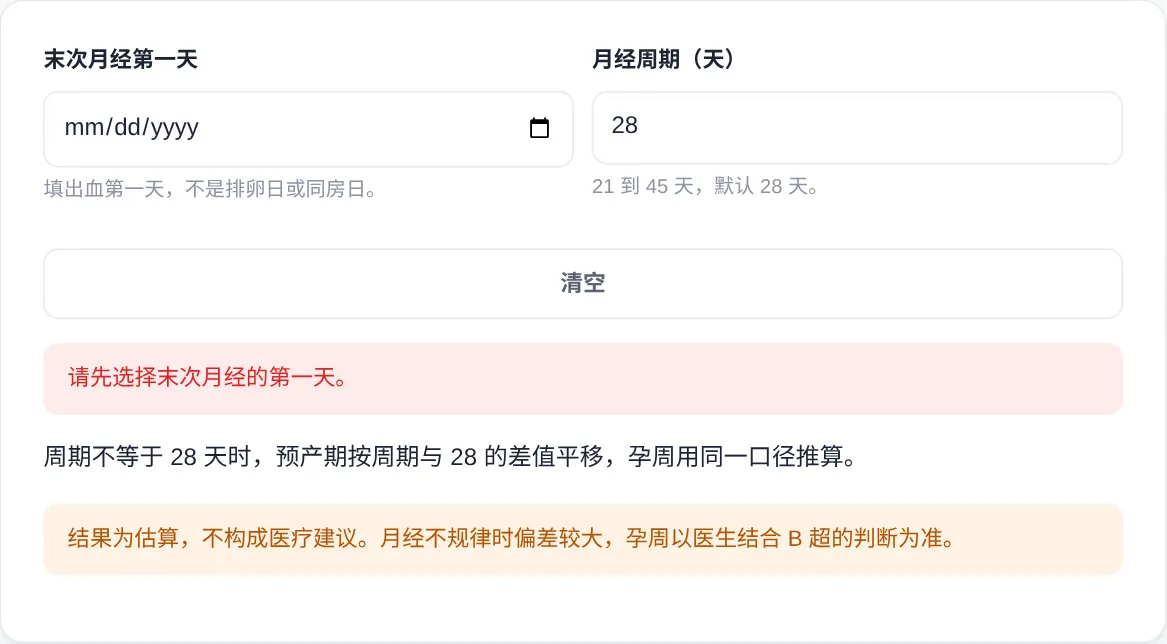
- Pick day one of your last period. The whole estimate shifts with this starting point.
- Set your average cycle length. The default is 28 days and any value from 21 to 45 is accepted.
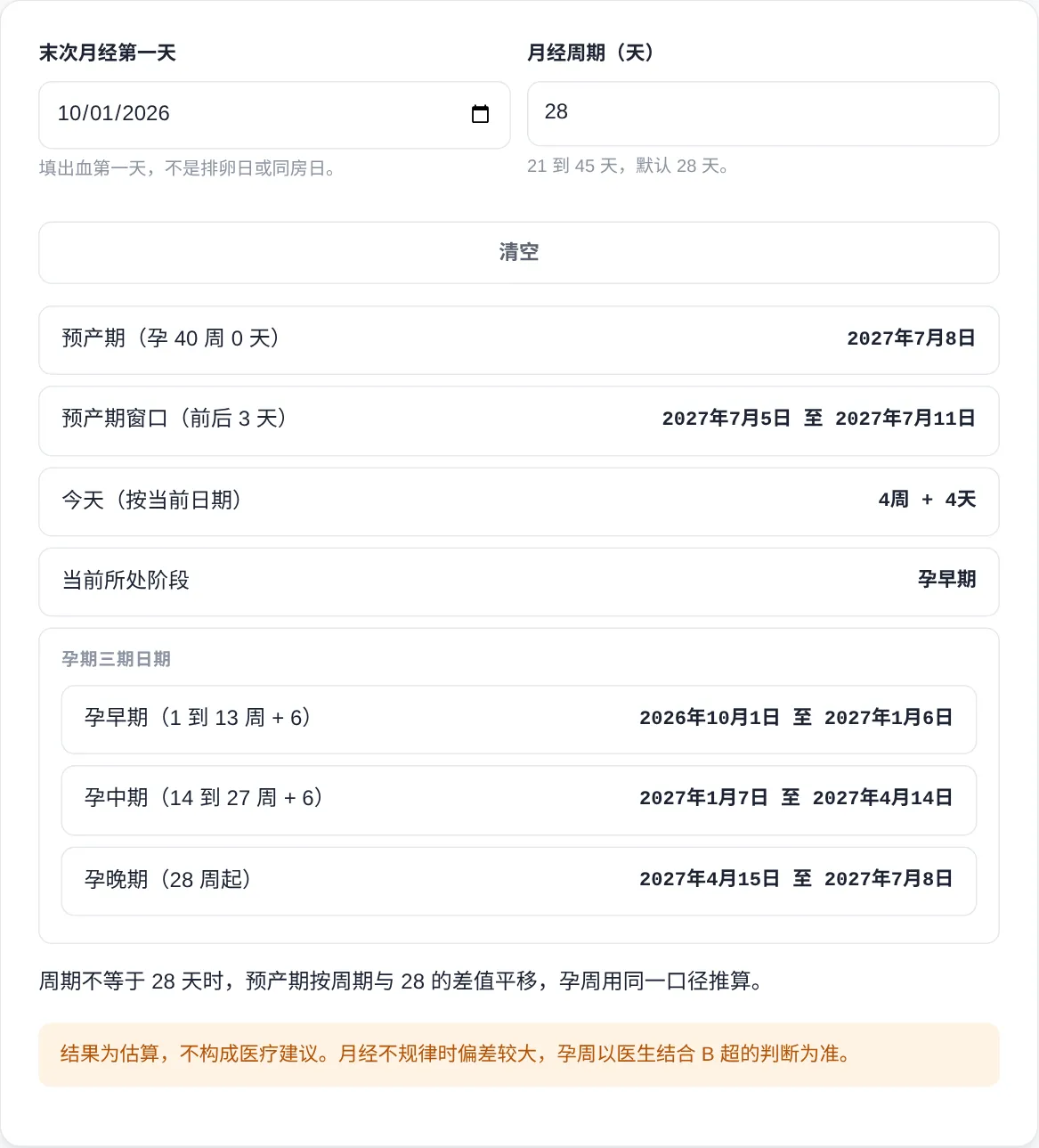
- The box shows the due date, the three day window, today's gestational age and the current stage.
- The trimester list gives start and end dates for each stage, handy for scans and leave plans.
- With irregular cycles, treat the result as rough and prefer the 11 to 13 week ultrasound dating.
Method and terms
How is the due date calculated?
When does the pregnancy count start?
My cycles are irregular. Is the result still valid?
How does IVF change the calculation?
Common questions
Will the baby arrive on the due date?
What if I pass the due date?
Is my data stored or uploaded?
Can this replace prenatal care?
Screenshots
How to use
- Enter the first bleed day
Pick day one of your last period, not ovulation or intercourse. The whole estimate shifts with this starting date.
- Confirm your cycle length
The default is 28 days. An average of your last three cycles is more accurate, and any whole number from 21 to 45 is accepted.
- Read the due date
The box shows the due date, a three day window on each side and today's gestational age in weeks and days. Most babies arrive between 37 and 42 weeks.
- Check the trimester dates
Three lines list the start and end dates of each trimester, handy for scans, glucose tests and leave plans.
About this tool
The due date marks 40 completed weeks counted from day one of the last menstrual period, 280 days in total. It assumes a 28 day cycle with ovulation on day 14, which is the standard obstetric convention. Only a small share of babies arrive exactly on the date, and most land between 37 and 42 weeks. The tool also shows a three day window for planning with family and employers. The estimate anchors prenatal care rather than predicting a birthday, and any decision near term belongs to your doctor.
This tool applies Naegele's rule: add 280 days to the last menstrual period. Then shift by the gap between your cycle and 28 days, so longer cycles push the date later. Today's gestational age uses the same adjusted clock and reads out weeks and days. The trimester ranges follow the standard boundaries at 14 and 28 weeks with their calendar dates. Results refresh as you type, dates stay on this device only and nothing is uploaded. With irregular cycles or assisted reproduction the error grows, so trust the ultrasound dating your doctor sets.
How it works
The rule carries the name of Franz Karl Naegele, a German obstetrician of the early nineteenth century. It assumes a 28 day cycle, ovulation on day 14 and a 280 day pregnancy from the last period. When the cycle is longer or shorter, ovulation usually drifts by the same amount, so the estimate shifts by the gap to 28 days. The luteal phase between ovulation and the next period stays near 14 days. That stability is why the shift works, and also where part of the error comes from. With erratic cycles the rule can only outline a rough range.
Ultrasound dating beats menstrual dating when cycles are irregular. A crown rump length measured between 11 and 13 weeks lands within about three to five days. Doctors often correct the date from that scan. Later scans drift more because fetal growth differs near term. Births spread across the 37 to 42 week band, and passing the date alone is not a diagnosis. Induction decisions combine monitoring, fluid levels and clinical protocol. This page supports planning only and is not medical advice, so contact your doctor about any pregnancy concern.
When to use it
- Dating an early pregnancy
After a positive test, estimate gestational age from your last period. Compare the number with your first ultrasound report and your symptoms. Arriving with one shared dating makes records easier and helps your doctor book the nuchal scan and the anomaly scan on time.
- Scheduling prenatal visits
Records open around week 12, the anomaly scan sits near week 20 and the glucose test runs between 24 and 28 weeks. Put the trimester ranges into a calendar, and the key scans stay covered while parental leave and family help get planned early.
- Talking about the date
A window communicates better than a single day. Give family and your employer the three day range plus the 37 to 42 week full term span. Booking a maternity nurse or relatives around that range removes most of the guessing and the stress.
Tips & tricks
- Check a calendar or a period app before picking the date, since filling it from memory often loses a day or two.
- Average the last three cycles, and record basal temperature when lengths swing, to confirm ovulation is regular.
- Copy the window and the trimester dates into your phone calendar, then hang scan reminders on those ranges.
Things to watch
- Counting from intercourse
Sperm can survive about three days, so conception may lag intercourse and reverse dating stays shaky. Obstetrics counts from day one of the last period for everyone. Mixing the two conventions shifts the whole estimate by about two weeks and causes needless confusion.
- Leaving the cycle at 28
A 32 day cycle entered as 28 pulls the due date four days early. Every week then looks ahead of itself. Record two or three recent cycles, take their average length, and fill that number in before relying on the result.
- Treating it as a deadline
The date marks 40 completed weeks, it does not expire. One or two days past is very common. Any induction decision belongs to your doctor together with monitoring and scans, and worry alone is never a reason to rush delivery.