UUID Generator
Generate random UUID v4 (GUID) values in bulk: up to 500 at once: with options for uppercase and no hyphens. Values come from your browser's cryptographically secure random source and are generated entirely locally.
How to use
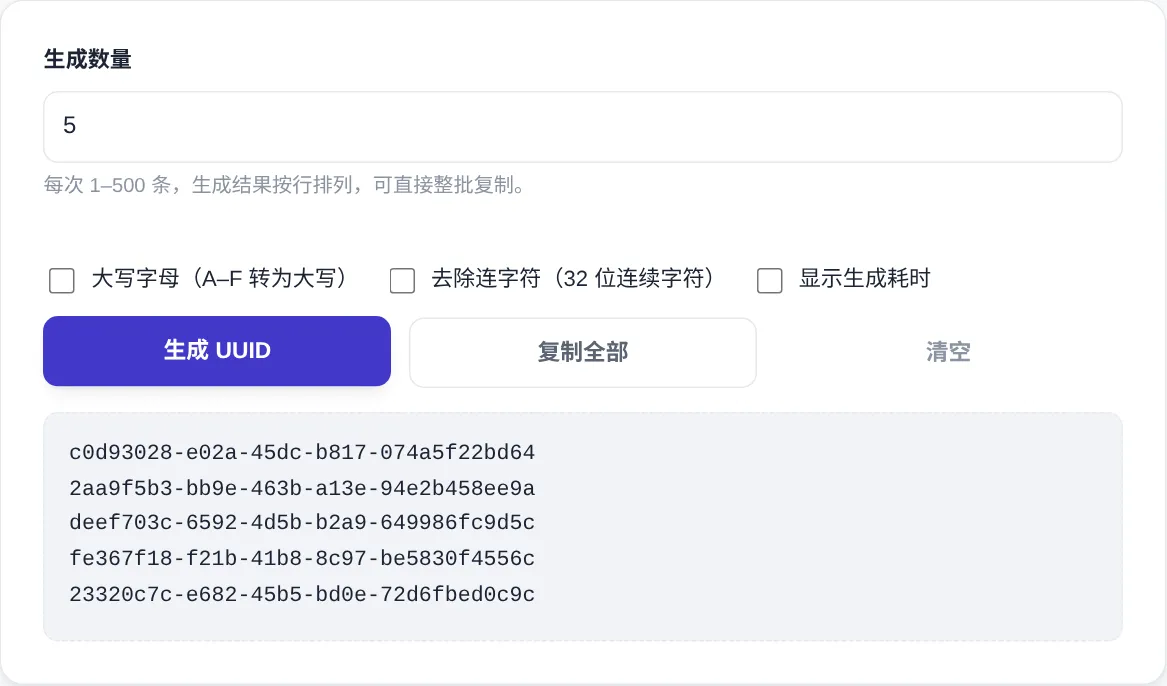
- Enter the number of UUIDs you need (1–500). Five are generated by default.
- Tick the options you want: uppercase letters, removing hyphens, or showing how long generation took.
- Click "Generate UUIDs" and the values appear one per line in the output area below.
- Click "Copy all" to put the whole batch on your clipboard, or "Clear" to remove the current result.
FAQ
What is a UUID and is it the same as a GUID?
Why does this tool generate UUID v4?
Does removing hyphens affect uniqueness?
Are the generated values uploaded or stored anywhere?
Screenshots

How to use
- Set the batch size
Enter 1-500 in Number of UUIDs; five are generated by default. Pull a full batch at once for API testing or bulk fixtures.
- Choose format options
Uppercase converts the hex letters to A-F. Remove hyphens yields a continuous 32-character string, a common shape for database keys and file names.
- Generate the list
Click Generate UUIDs and the output area fills with one v4 UUID per line. The values are random-based, with no timestamps or machine identifiers embedded.
- Copy the whole batch
Press Copy all to take the entire batch into your clipboard, ready for config files, SQL scripts or test cases. Clear removes the current output.
- Pick a shape per use case
Keep hyphens when humans will read or compare values. Use the 32-character form for cache keys and file names where compactness matters.
About this tool
A UUID is a 128-bit globally unique identifier, normally written as a 36-character hex string grouped 8-4-4-4-12. GUID is simply Microsoft's name for the same standard. This tool produces version 4 UUIDs built entirely from random numbers drawn from the browser's cryptographic source. There is no registry, no timestamp leakage, and a negligible collision probability.
v1 differs from v4 in its source. v1 values derive from timestamps and network addresses and can reveal when and where they were made. v4 is pure randomness, suited to API testing, database primary keys and session IDs. Removing hyphens only drops a readability separator, leaving the information content and uniqueness intact.
How it works
Of a v4 UUID's 128 bits, 6 are fixed: the version nibble and the variant bits. The remaining 122 bits are random. Birthday-bound arithmetic: one trillion generated values still carries less than a 10^-13 chance of a single collision. Producing a billion per second for roughly 85 years yields only a coin-flip chance of ever seeing one. Distributed IDs, idempotency keys and offline record creation all treat non-collision as a premise, and those 122 random bits fund that premise. No registry is involved.
The format is defined by RFC 4122 and folded into RFC 9562 in 2024, which also standardised the time-ordered v7. Hyphens are presentation only; the information is sixteen bytes, which is why the hyphenless 32-character form suits cache keys. Native UUID column types in some databases insist on the canonical shape, so check the target column before importing. Random UUIDs also scatter B-tree index writes across the tree, causing page splits as tables grow. That is one reason ordering-friendly versions were added to the standard, and write-heavy tables should consider v7 or an auto-increment column.
When to use it
- Seeding API test fixtures
A local service has no real business IDs yet, so generate fifty v4 values into request bodies. Exercise idempotency and dedupe paths with them; the format is guaranteed valid and Clear resets between runs.
- Tracing requests across services
Stamp each request with a UUID that travels through every microservice hop, then grep once to see the whole trail. Random v4 values leak no machine data when they land in public logs.
- Offline-first primary keys
A client that creates orders offline mints a UUID locally as the primary key, and syncing later cannot collide with the server. The whole create-now-sync-later pattern rests on that uniqueness.
Tips & tricks
- Random v4 values carry no timestamps or device data, making them safer in public logs and external APIs.
- The 32-character hyphenless form suits cache keys and file names. Same information, same uniqueness, just tighter.
- Tick Show generation time to see how fast a batch runs; 500 UUIDs typically finish in milliseconds.
Things to watch
- A UUID is not a secret
Guessing 122 random bits is impractical, but the standard does not define UUIDs as keys. It also says nothing about implementation quality. Session tokens belong to a dedicated secret generator, not this tool.
- Native columns want canonical form
Hyphenless or uppercase strings may be rejected by a database's native UUID column type. Check the target column before importing, or store the adjusted form in a plain text column instead.
- Random keys fragment indexes
Purely random primary keys scatter inserts across a B-tree, causing page splits and write amplification as tables grow. For write-heavy tables consider time-ordered v7 or a surrogate auto-increment column.